
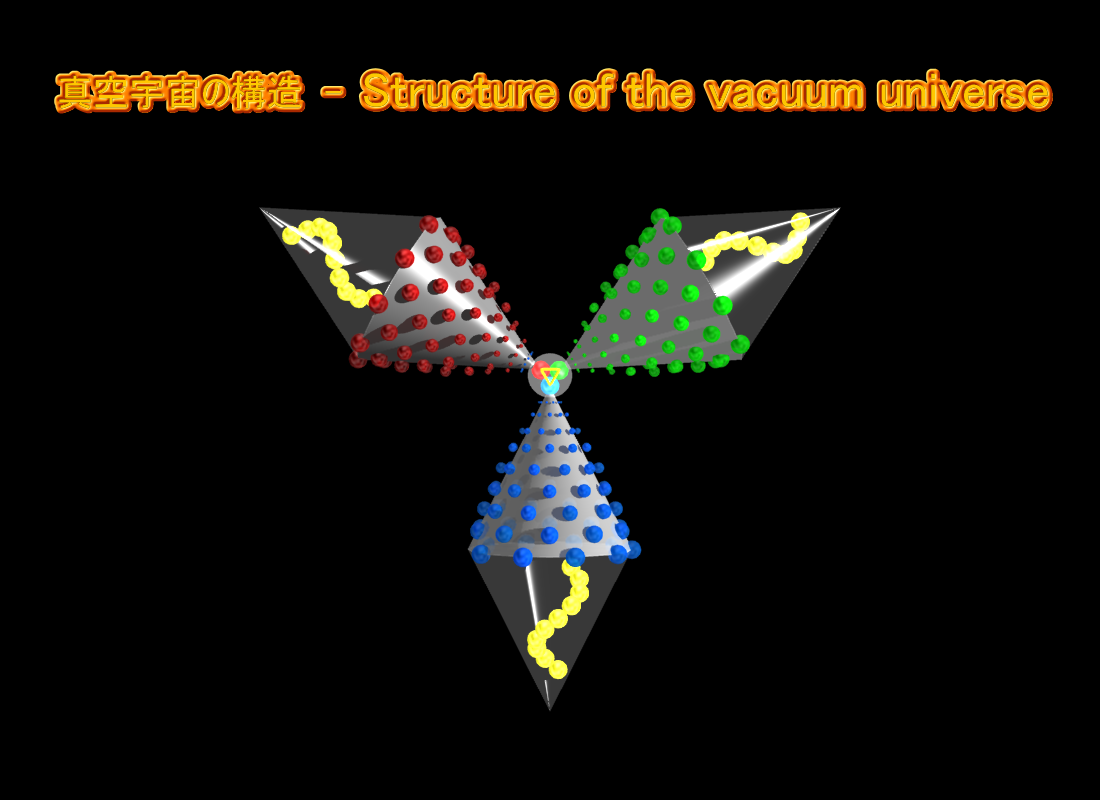
(This is a machine translation. Please pardon any unnatural sentences)
【1】Unit amount of light = the origin of time and space
Light has no speed (unit quantity) = A unit quantity of light has a speed that exists before the material universe (3-dimensional spatiotemporal quantity)
① Light (calculated spatiotemporal quantity)
■The unit amount of light that does not contain true physical particles = does not generate the concept of mass.
■Reaching the total amount of interaction = particle of light = does not generate the concept of mass. However, when trying to determine it as a space-time quantity, it has a unit division amount (unit imaginary distance amount = energy).
②Matter (physical spatiotemporal quantity)
■The unit amount of light that contains true physical particles creates the concept of mass.
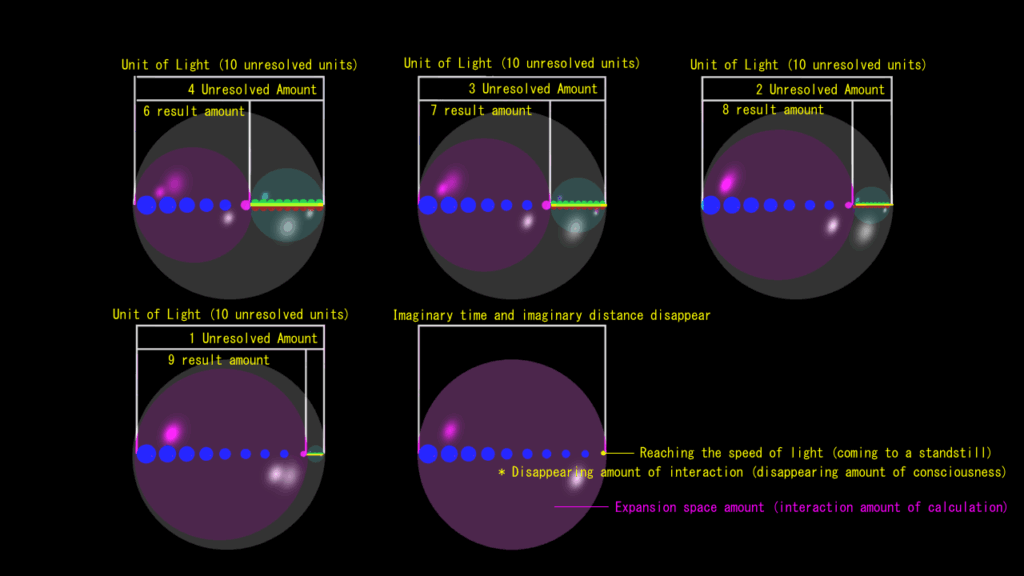
■Reaching the total amount of mass concept = matter particles reaching the speed of light.
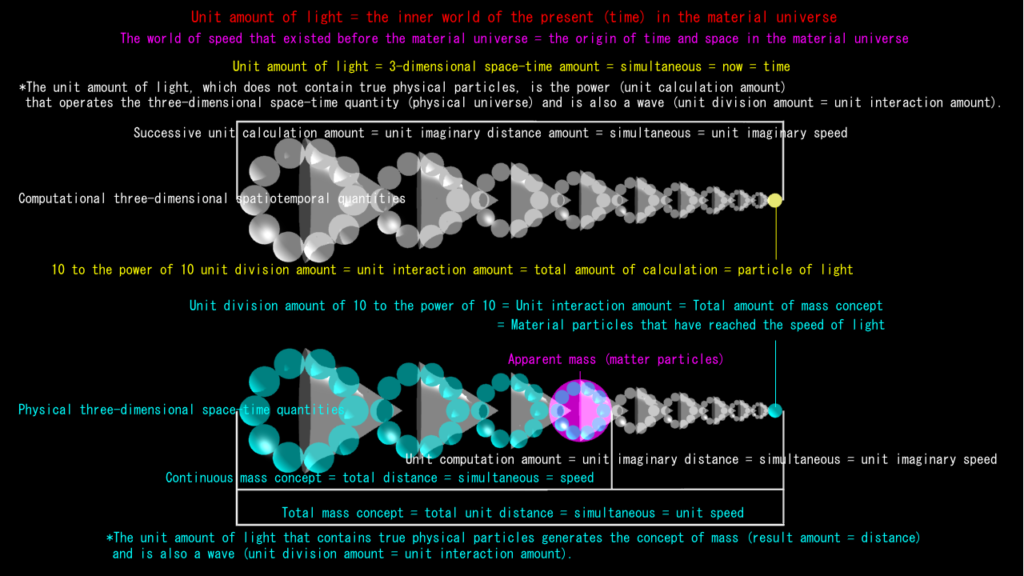
【2】Unit quantity of light = pair of universal imaginary distances = one thing
The speed of light is the accumulation of a continuous series of units of light (unit computational amount = unit imaginary distance amount)
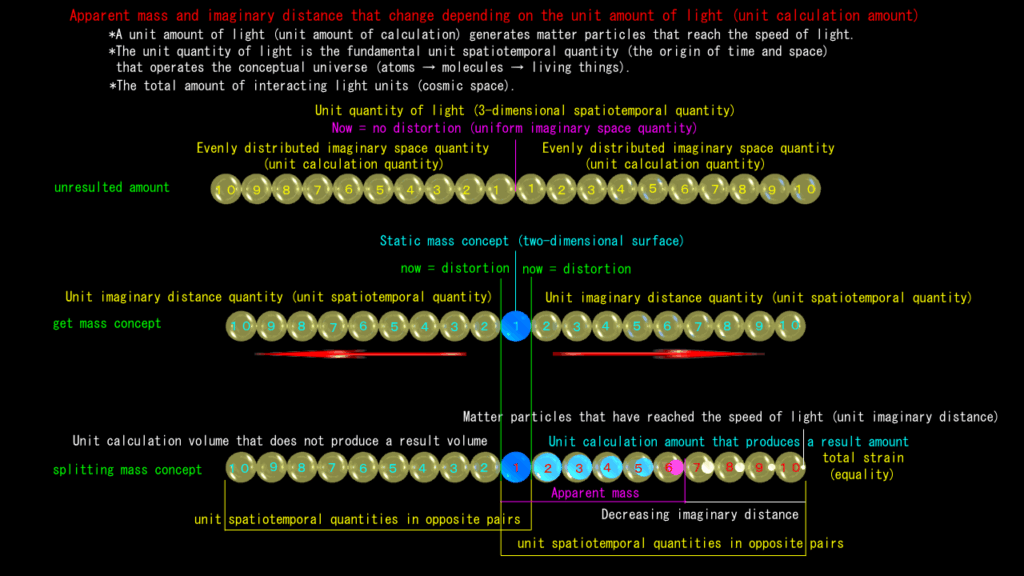
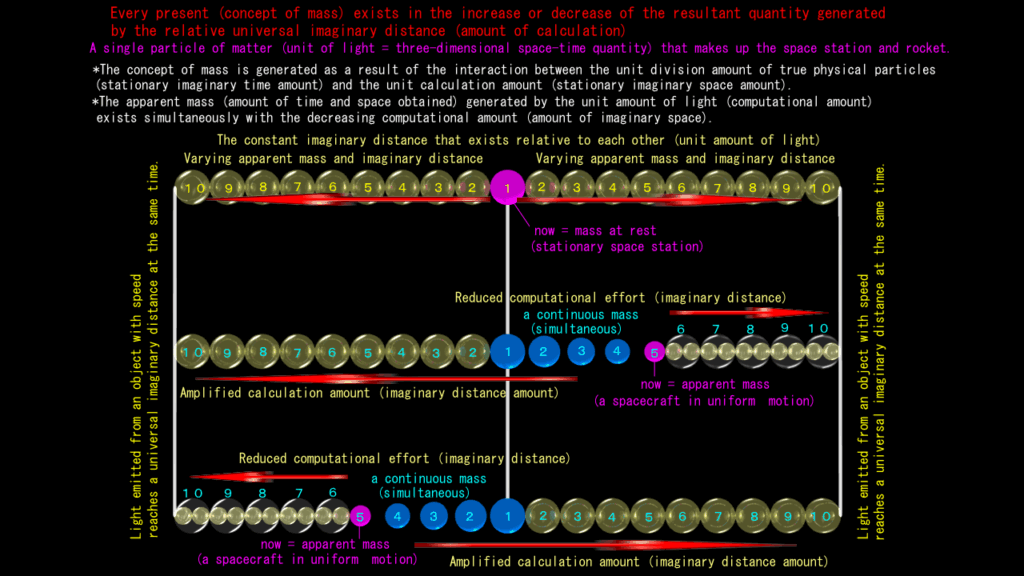
■There is an apparent mass (result quantity) and an imaginary distance quantity (calculation quantity) that increase or decrease in the relative universal imaginary distance quantity (unit calculation quantity).
【3】The principle of the constancy of the speed of light
The result (apparent mass) obtained with a unit amount of light (unit calculation amount = unit imaginary distance amount) and the decreasing calculation amount (imaginary distance amount)
■The constant speed of light does not mean that the speed of light, which is approximately 300,000 kilometers per second, remains unchanged.
■When an object moves (has speed), it is a continuous accumulation of units of light (determined by apparent mass and imaginary space) (in the world of speed, the relationship between time and space is already determined).
■The relationship between time and space exists within the unit amount of light.
■Even if the apparent mass and imaginary space quantity are determined, the corresponding universal imaginary distance does not change (Doppler effect).
A stationary particle of matter (the concept of mass) is at the center of a unit quantity of light (the corresponding universal imaginary distance).
If you try to move towards a certain point, an apparent mass (result quantity = obtained distance) is generated at the selected universal unit imaginary distance, and the imaginary distance (amount of calculation) that you are trying to approach decreases.
Also, if you try to move away from a certain point, the amount of calculation is added to the unselected universal unit imaginary distance, and the imaginary distance that you are trying to move away from increases.
(Image1)
(Image2)
【3-1】Time and space
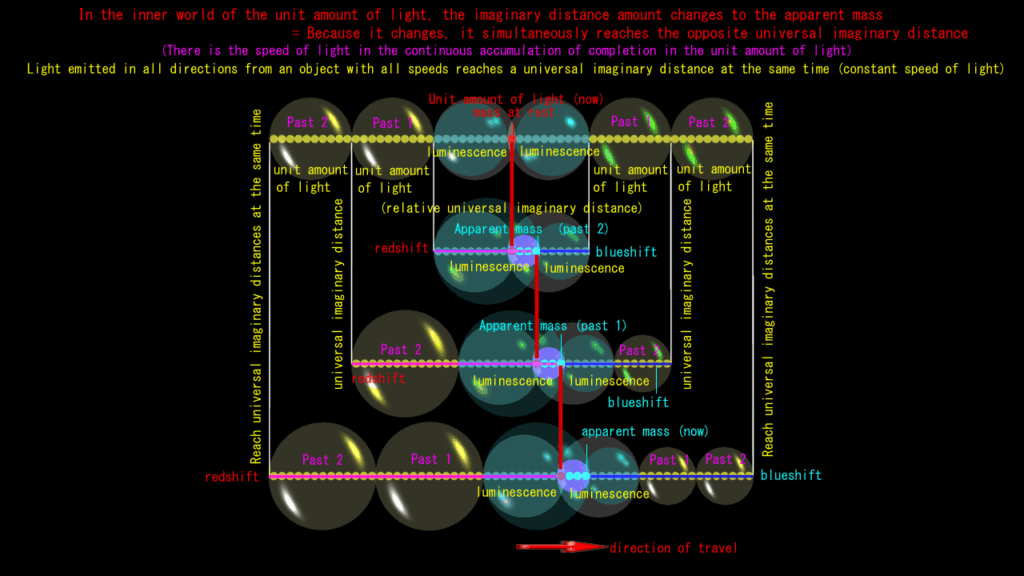
The relationship between time and space is in the inner world of the unit amount of light (simultaneous), and it exists before the speed of light and the speed of movement of objects.
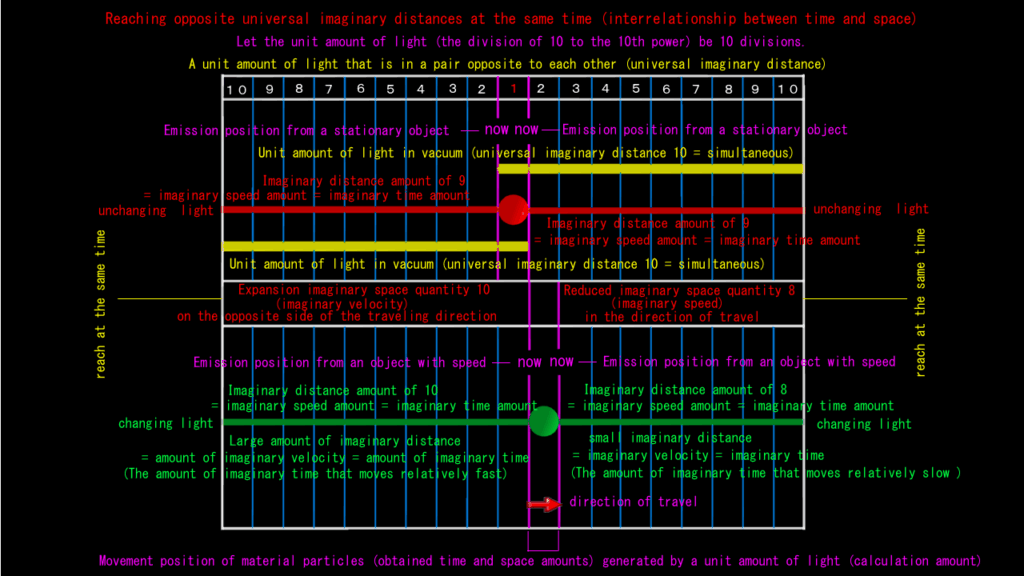
Light emitted in opposite directions from a stationary light emitter and light emitted in opposite directions from a fast light emitter simultaneously reach a unit amount of light (relative universally imaginary distance).
And even if it is not possible to compare the relative speed with others, it is in the position between the apparent mass and the imaginary space quantity that is two sides of the same coin in the inner world of the unit amount of light.
■ Observation from a stationary space station
(1) The amount of computation (imaginary number space) and the amount of interaction (imaginary number time) are reduced in the traveling direction of a rocket that moves uniformly at half the speed of light compared to stationary space station.
= The light and time emitted in the traveling direction of the space rocket progress slowly and reach the unit amount of light (universal imaginary distance).
(2) On the opposite side of the direction of travel, there is an increased amount of computation (quantity of imaginary space) and an amount of interaction (quantity of imaginary time) increased compared to a stationary space station.
= The light and time emitted in the opposite direction of the traveling direction advances quickly and reaches the unit amount of light (universal imaginary distance).
■ Observation from a rocket moving at half the speed of light
(1) The static space station has an increased amount of computation (quantity of imaginary space) and an amount of interaction (quantity of imaginary time) increased compared to the traveling direction of the rocket.
= The light and time emitted from a stationary space station in the direction of travel of the rocket travel quickly and reach the unit amount of light (universal imaginary distance).
(2) The stationary space station has a reduced amount of computation (quantity of imaginary space) and a quantity of interaction (quantity of imaginary time) reduced compared to the opposite side of the direction of travel of the rocket.
= The light and time emitted from the space station to the opposite side of the rocket’s traveling direction progress slowly and reach the unit amount of light (universal imaginary distance).
(Image1)
(Image2)

(Image3)
(Image4)
【4】The outside world of a unit amount of light
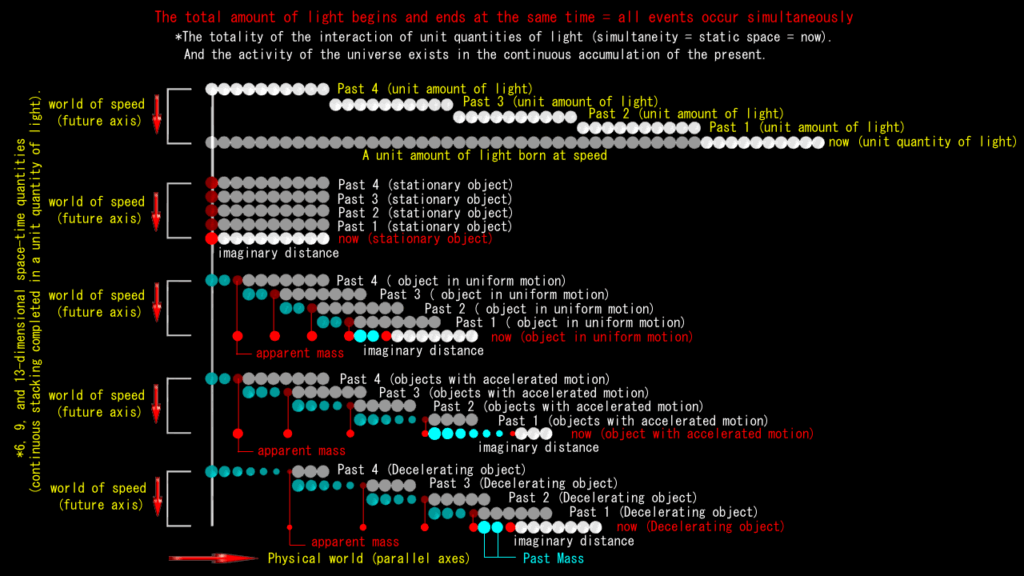
The world of speed is born from the continuous accumulation of completion (stillness = now) in the unit amount of light
■Unit amount of light (3D spatiotemporal amount = unit interaction amount = generation of material particles that reach a unit amount of light).
■The atomic concept universe (six-dimensional spatiotemporal quantity) generated from material particles operates as a continuous stack of units of light (the speed of light is born).
■The molecular concept universe (9-dimensional spatiotemporal quantity) → biological concept universe (13-dimensional spatiotemporal quantity) also operates as a continuous stack of units of light (it seems that light has a speed, but this is just a continuous stack of unit quantities of stationary light).
■Material particles generated by a unit amount of light (objects and space are fixed).
■Objects do not move through space. However, they appear to move through space as a continuous accumulation of units of light.
Completed in the unit amount of light (determined in apparent mass and imaginary space amount = simultaneous = rest = now). And in the continuous accumulation of completion (now) in the unit amount of light, there are phenomena such as rest, uniform speed, acceleration, and deceleration.
【5】Unit interaction result amount = now = time
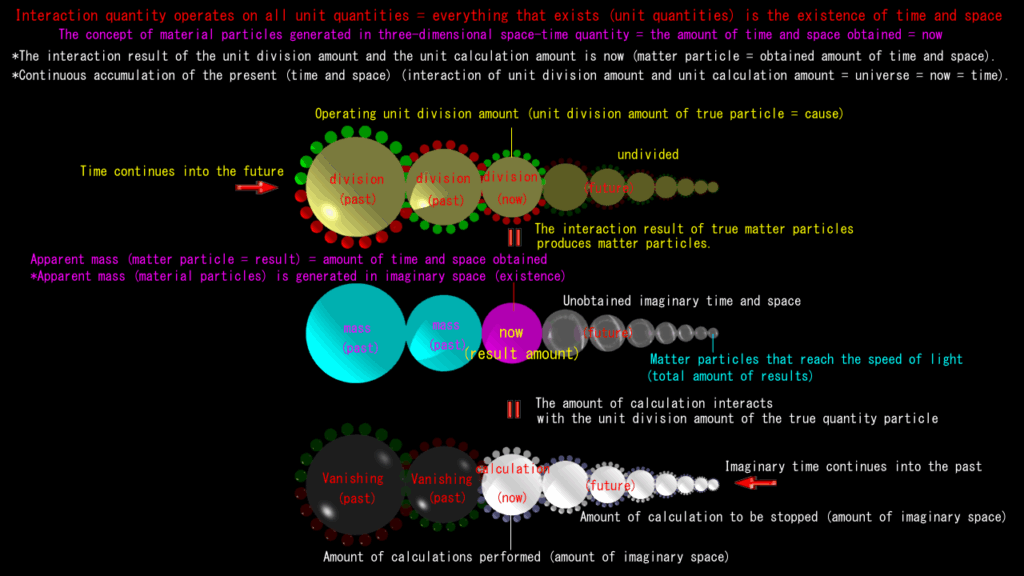
The interaction result of the unit division amount of true matter particles (stationary imaginary time amount = cause) and the unit calculation amount (stationary imaginary space amount) (total mass concept = matter particle = now = time)
■The origin of time lies in the unit amount of light (three-dimensional spatiotemporal amount) = the material universe operates as a continuous accumulation of completed unit amounts of light.
■Time in the material universe (now) is completed in material particles = material particles are generated using the amount of time and space they have.
■Matter particles (the amount of time and space obtained = now) have imaginary time and imaginary space amounts (now) that they have not obtained.
【5-1】Time proceeds uniformly in the continuity of the completion(now) of a unit quantity of light
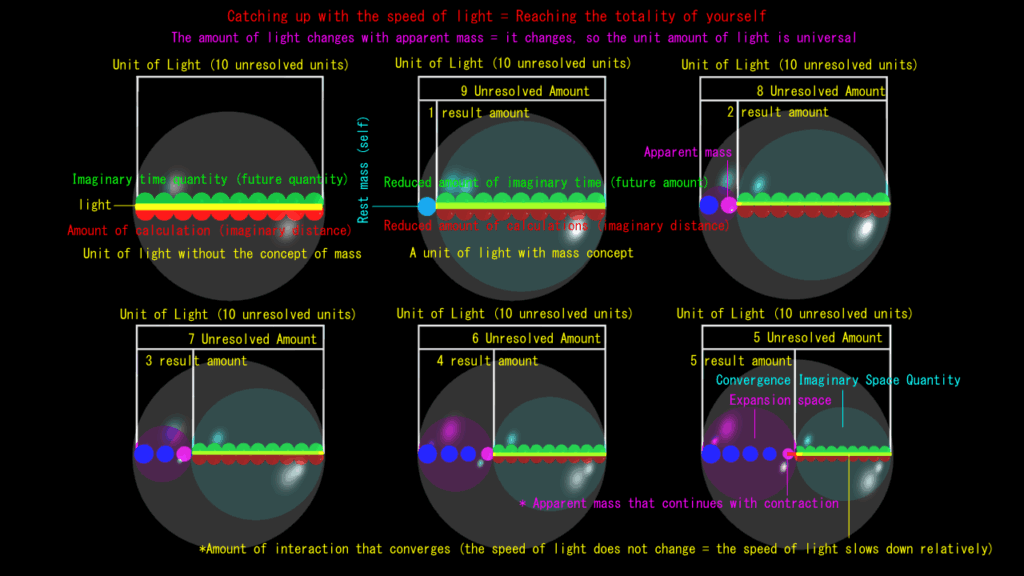
There is an increase or decrease in apparent mass (amount of time and space obtained) and unresolved amount (amount of calculation = amount of imaginary space) in the unit amount of light.
■The origin of time is completed in the unit amount of light (three-dimensional space-time amount = apparent mass and imaginary space amount = simultaneous = now).
■Time (now) in the atomic universe and molecular universe progresses at a constant rate = time (now) in the biological universe, which was born from the 10-dimensional material universe, also progresses at a constant rate.
■The time and space perceived by living organisms (concepts) refers to the amount of imaginary time and imaginary space (time and space = the generation of material particles).
【5-2】Time that seems to be moving at a constant pace (now) is slowing down
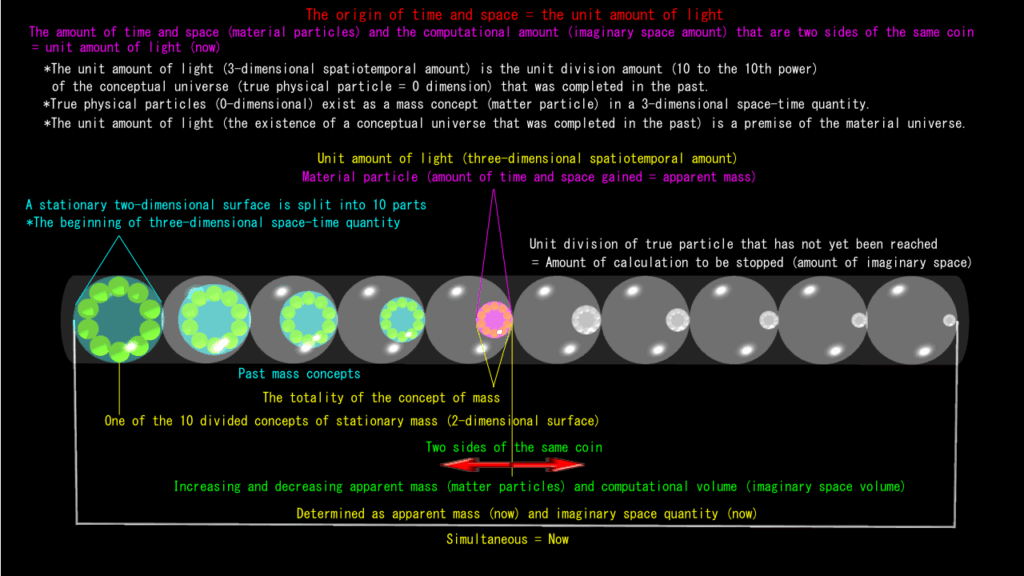
Completion (now) in unit interaction amount is a universal concept = From the past to the future, the unit interaction amount amplifies and is completed relatively slowly (now)
■Stationary two-dimensional surface (stationary mass concept = stationary material particles).
■One two-dimensional surface (mass concept) reaches the total amount of unit interactions and stops = it operates into a further unit division amount (unit interaction amount).
■A unit division quantity cannot be created using only a two-dimensional surface = The two-dimensional surface is divided into units into four-dimensional multi-worlds (a new unit interaction quantity).
■Completing the unit interaction amount on a two-dimensional surface results in apparent mass (material particle) (unit amount of light = distance obtained within imaginary distance).
■The more apparent mass (matter particles) are generated, the more calculations are required, and the more unit divisions (unit interaction amounts) into four-dimensional multi-worlds are required.
■Apparent mass (matter particles) in the past complete quickly (time = now) with a small unit division amount (unit interaction amount). And apparent mass (matter particles) in the future complete relatively slowly (time = now) with a large unit division amount (unit interaction amount).
■The atomic concept universe, molecular concept universe, and biological concept universe also operate on the same principle.

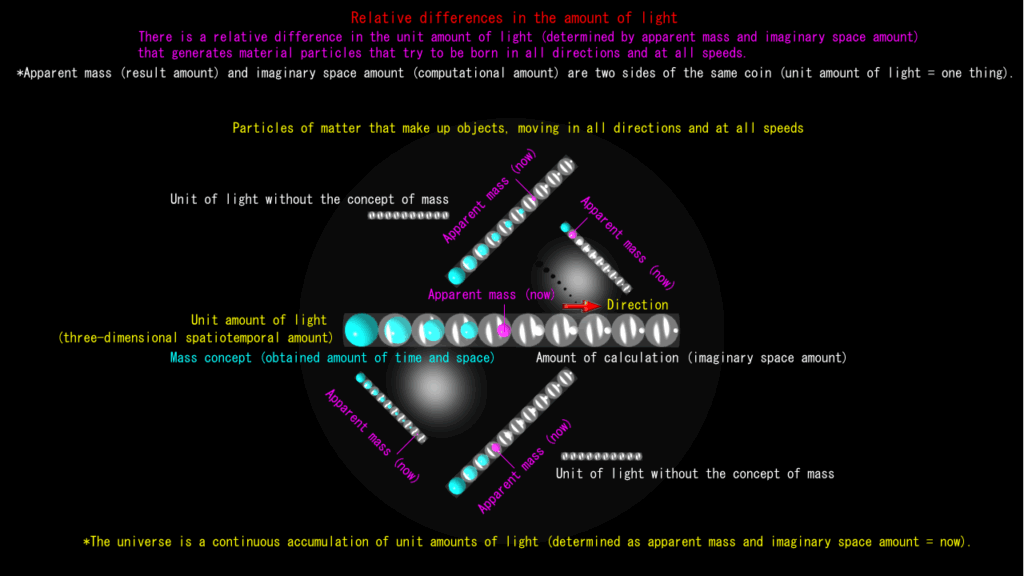
【5-3】Each unit amount of light(determined in time and imaginary space = now) is a relative difference.
All events occur simultaneously
■Space is the totality in which unit quantities of light (unit amounts of calculation) interact with each other.
Objects that are stationary, moving at a constant speed, accelerating, or decelerating. The material particles that make up each object operate within the bounds of a unit of light (the interrelationship between time and space). As long as they exist within the bounds of a unit of light, all objects can recognize each other.
【6】Time exists in the relative difference between dimensions (the concept of time is universal)
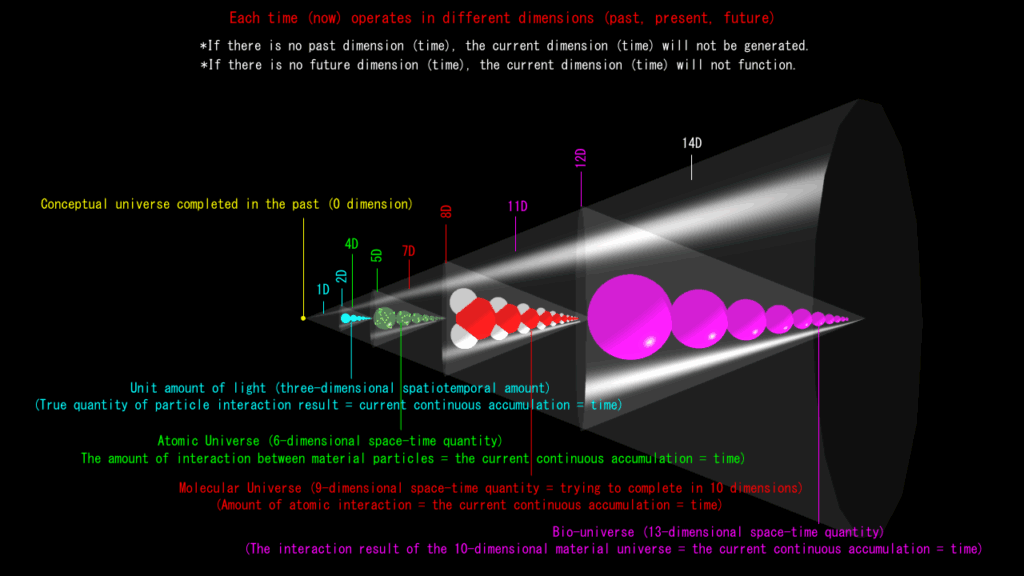
Everything is in one thing (universal) = the unit space-time quantity of one thing (the past dimension, the present dimension, and the future dimension) is in relative difference
■There are concepts of the past (many worlds) that have been split into the inner world of the present (concept = one thing)
= the present (concept = one thing) is part of the concept of the future (many worlds).
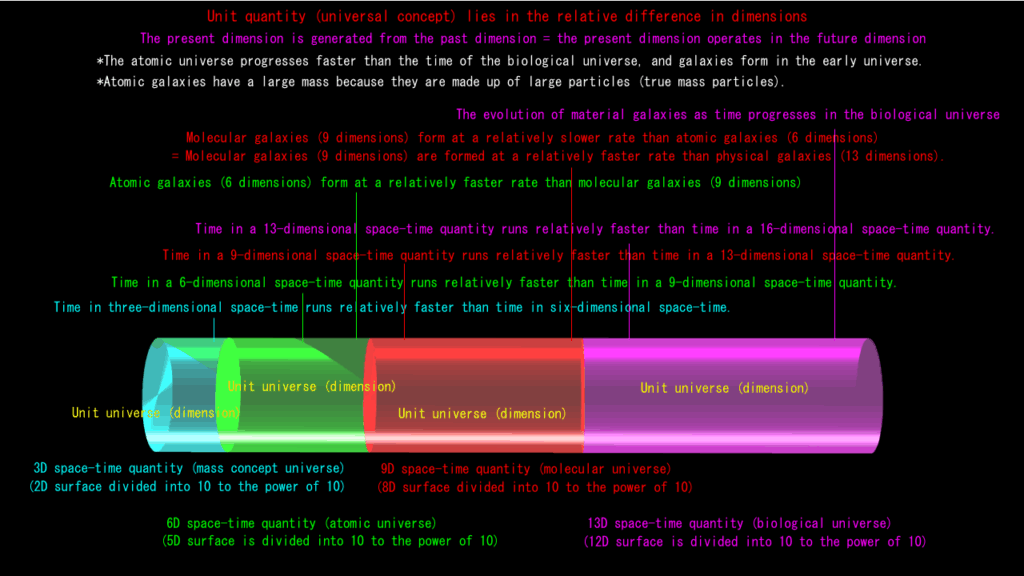
■The flow of time in the current dimension (unit space-time amount) is relatively slower than the flow of time in the past dimension (unit space-time amount) (big concept) = the flow of time in the current dimension (unit space-time amount) is relatively faster than the flow of time in the future dimension (unit space-time amount) (small concept).
The concept of a matter particle (three-dimensional space-time quantity) is the interaction of unit divisions of true matter particles (complete in zero dimensions)
→ The concept of an atom (six-dimensional space-time quantity) is the interaction of unit divisions of matter particles (complete in three dimensions)
→ The concept of a molecule (nine-dimensional space-time quantity) is the interaction of unit divisions of atoms (complete in six dimensions).
Material particles (dimensions), atoms (dimensions), and molecules (dimensions) have unit calculation amounts to determine their existence (result amount = recognition = now = time). The concept of time is universal, but it is a relative difference between dimensions.
◕The concept of life (13-dimensional spatiotemporal quantity) recognizes the concept of mass (3-dimensional spatiotemporal quantity) within its inner world (it can recognize the speed of light).
In contrast, atoms → molecules → objects → living things, which are composed of material particles at their root, operate within the inner world of the unit quantity of light and cannot exceed the speed of light.
◕The concept of mass (self = now) that was born in the conceptual universe cannot be seen as complete (its true form) within itself. It exists as a part (now) of the self (total amount of consciousness = amount of space-time), and the concept of mass (the amount of time and space obtained) can only be recognized from the amount of consciousness that exists in the present.
(Image1)

(Image2)
(Image3)
【7】A world of speed
Further gravitational binding = amplifying mass = continued deceleration
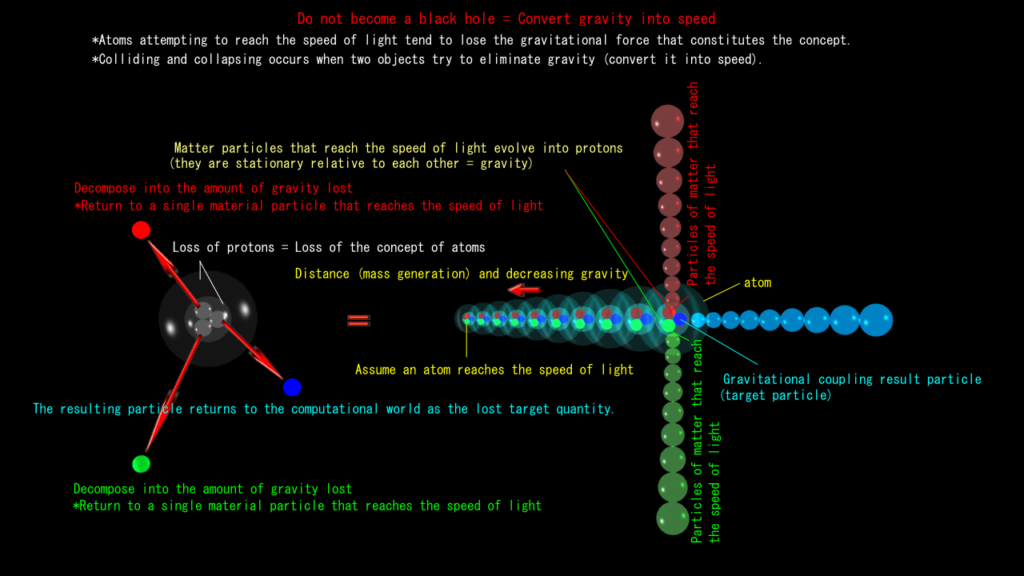
Combination of material particles (mass concept) that have reached the speed of light (evolves into protons = stands still relative to each other = converts speed to gravity). And there is a speed due to the attraction between protons (deceleration from the speed of light)
→Evolves into the type and number of atoms (amplifying protons that stand still = amplifying gravity). Then there is the speed (further deceleration) due to the attraction between the atomic nuclei (amplified mass).
→Evolves into the type and number of molecules (atom that is amplified and stationary = amplified amount of gravity). Then there is the speed (further deceleration) due to the attraction between the molecules (amplified mass).
→Evolves into an object (atom and molecule that are stationary relative to each other amplify = amount of gravity that is amplified). Then there is the speed (further deceleration) due to the gravitational force between objects (amplified mass).
And then there is the current speed of the universe.

【8】There is no diagonal in the world of calculation
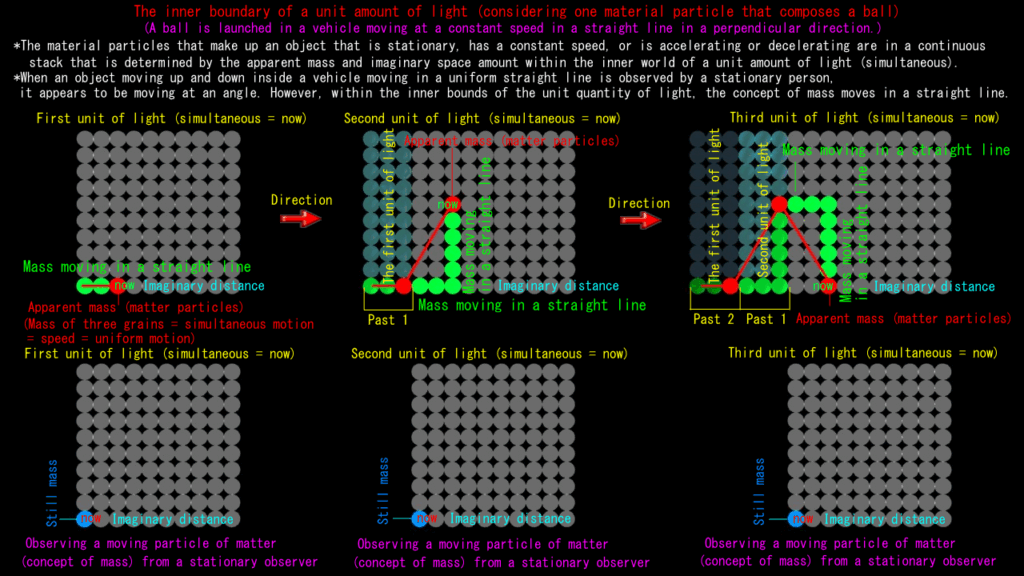
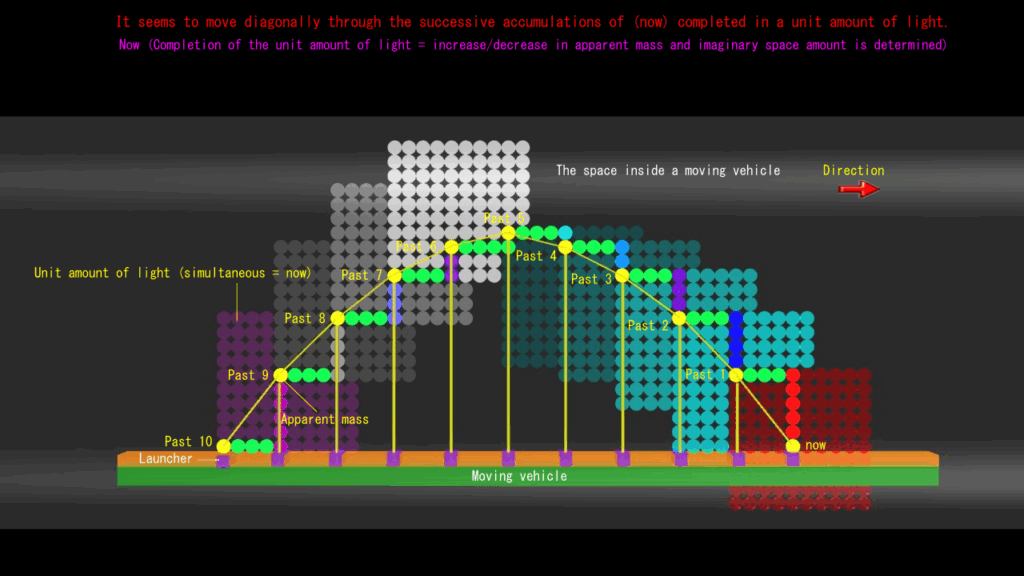
■The concept of mass is completed in the distance perpendicular to the straight distance obtained for the unit amount of light (unit calculation amount). It is recognized as proceeding diagonally in the continuous stack.
If a ball placed on the floor inside a train moving at a uniform speed is launched towards the ceiling inside the train, the ball will return to the position where it was launched.
When the ball is launched, the train moving at a uniform speed and the material particles that make up the ball inside it are already between the apparent mass and the reduced amount of imaginary space (distortion = position = now) within the inner world of the unit quantity of light.
And a stationary observer watching a ball launched inside a train moving at a uniform speed return to the position where it was launched will perceive it as moving diagonally upwards, then diagonally downwards, returning to the position where it was launched (the relative difference in positions within the inner world of the unit quantity of light between something that has speed and something that is stationary).
(Image1)
(Image2)
【9】Objects do not move in space
The concept of mass propagates through the computational world = objects and space are two sides of the same coin
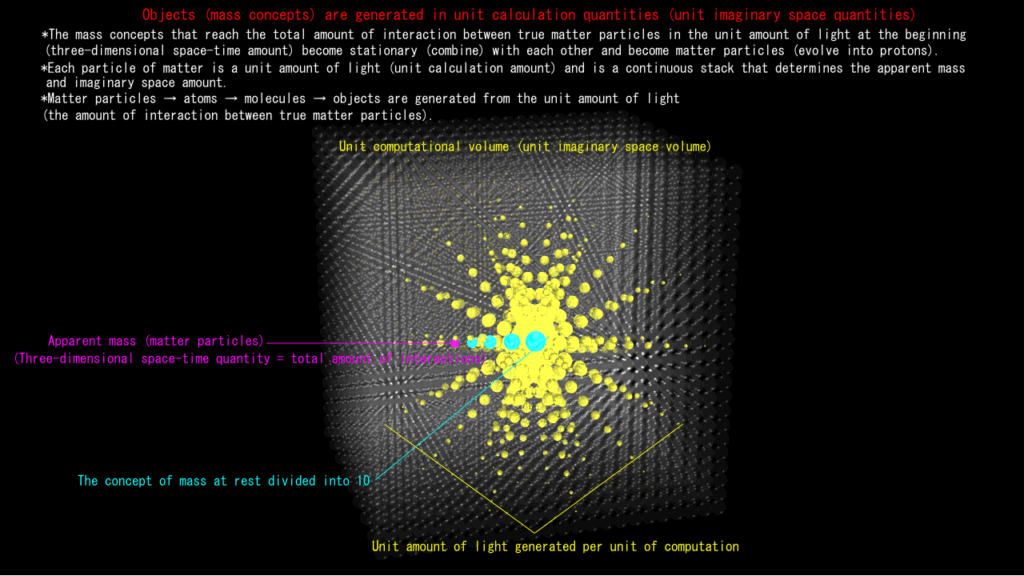
■The three-dimensional space-time quantity (unit amount of light = unit calculation amount) interacts with the unit division amount of the conceptual universe (true quantity particle = 0 dimension) that was completed in the past.
■The unit division amount of a true physical particle (0-dimensional) is generated as a stationary two-dimensional surface (mass concept).
■There is a split amount of the mass concept in the three-dimensional imaginary space quantity (apparent mass and imaginary space quantity are determined = now).
■True physical particles operate with a new unit amount of light (unit calculation amount) at the same time as the completion of a unit amount of light.
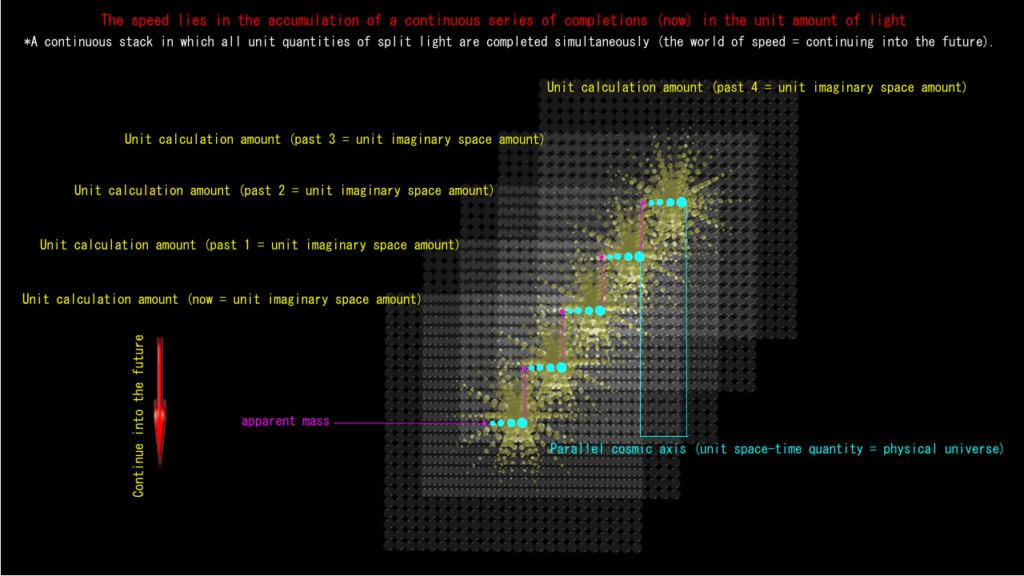
■Space is the sum of the divisions of unit quantities of light (simultaneous = one thing). Space is also a continuous stack in which all unit quantities of light are completed simultaneously (continuous into the future = the world of speed).
■Objects composed of true physical particles as their source are continuous stacks that always operate (propagate = interact) in space (unit calculation amount = unit imaginary space amount).
(Image1)
(Image2)
【10】reaching the end of the universe
I don’t know what’s beyond the end of the universe = I don’t know the end of the universe
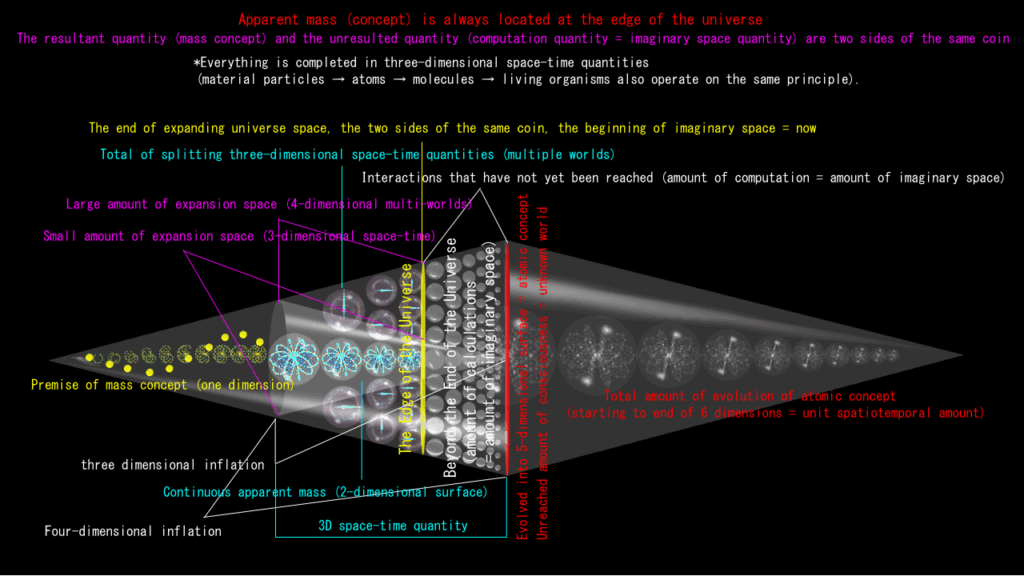
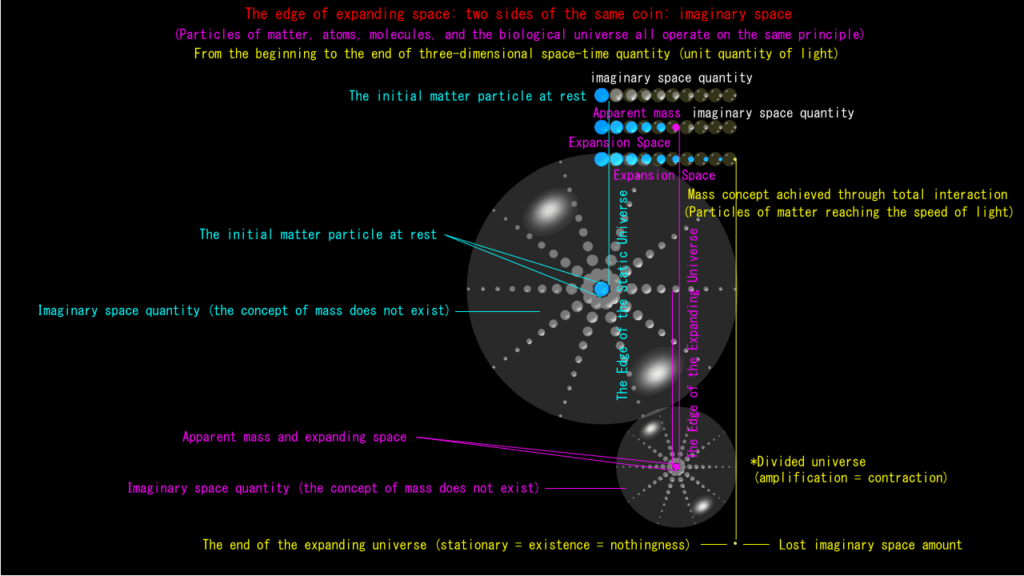
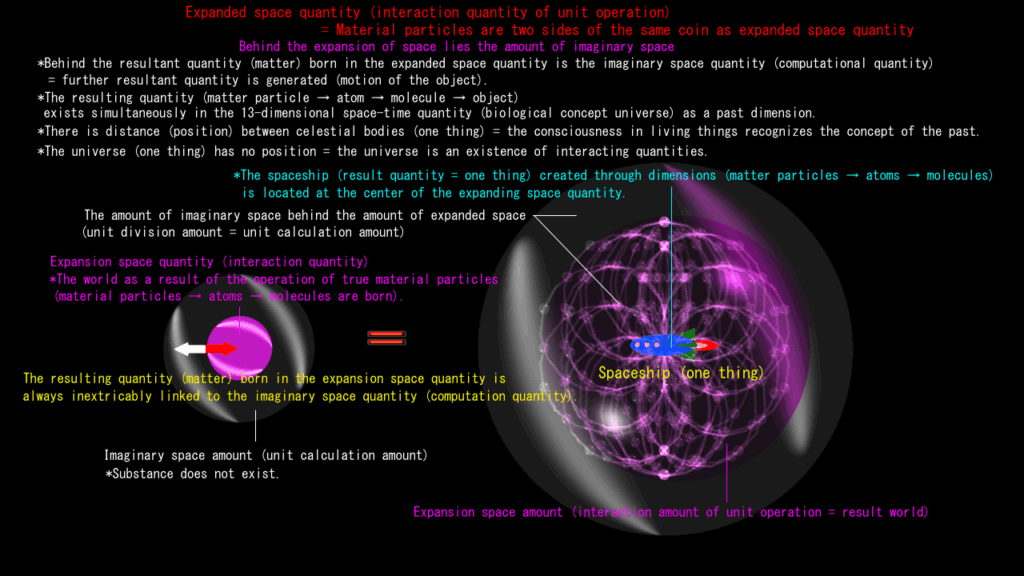
■The boundary between the amount of calculation that has been reached (the concept of mass and the amount of expanding space = now) and the amount of calculation that has not been reached (the amount of imaginary space = now), which is two sides of the same coin, is the edge of the expanding universe.
■The existence of three-dimensional space-time quantity (concept) cannot see or touch the five-dimensional surface (further concept) (unreachable unit division quantity = inactive interaction quantity = does not exist = true quantity).
■The unit division amount (stationary imaginary time amount) interacts with the unit calculation amount (unit imaginary space amount) (the next to the end of the universe already exists as consciousness).
The resultant quantity (apparent mass and expanded space quantity = now) is inextricably linked to the unresulted quantity (computation quantity = imaginary space quantity = now). The apparent mass (now) generated in the three-dimensional space-time quantity (unit computation quantity) is always located at the boundary (edge of the universe) with the imaginary space quantity (remaining computation quantity).
However, we do not know where the edge of the universe is (we do not know what lies beyond the edge of the universe = we do not know the boundary between the known world and the unknown world).
3-dimensional space-time quantity (mass concept) → 6-dimensional space-time quantity (atomic concept) → 9-dimensional space-time quantity (molecular concept) → 13-dimensional space-time quantity (biological concept) also operate on the same principle (the edge of the universe is getting further away = it is always located at the edge of the universe).
(Image1)
(Image2)
【10-1】It is not possible to reach the edge of the expansion space by physical means
All matter particles (self = resultant quantities) are at the center of the universe
■The totality of the interactions of unit quantities of light is the space of the universe (one thing).
■Every unit amount of light (self) exists in pairs with every unit amount of light (other) = every unit amount of light has no position.
■Every self (one thing) is at the center of every other (many worlds).
■Material particles (result amount) born from the interaction amount (expanded space amount) of the unit amount of light (unit calculation amount).
■All of the resulting quantities (atoms → molecules → objects) produced by the interaction of material particles are at the center of the expanding universe.
Born as a living organism (self) whose origin is material particles, and obtaining a means of transportation using matter whose origin is material particles, even if you try to travel in all directions toward the end of the expanding universe, you will end up at the center of the expanding space (the beginning of the universe is in all directions).
【11】Concept Gravity at the end of the universe = Black hole
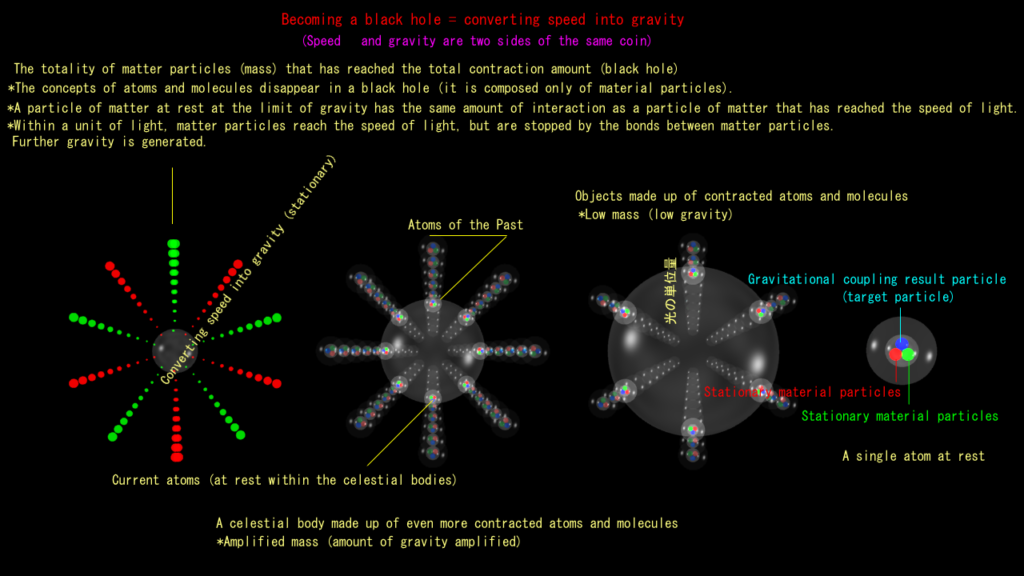
Speed (total distance = simultaneous) is converted into gravity (stationary) =Gravity (stationary)is converted into speed(total distance = simultaneous)
■Gravity amplifies as matter accumulates = the amount of gravity exceeds the amount of gravity that created the atom.
■The material particles that make up a black hole are stationary, but are in the same state as the total amount of interaction (material particles that have reached the speed of light)due to extreme gravity.
■The concepts of atoms and molecules disappear when material particles reach the speed of light.
■The totality of matter particles that reach the speed of light but are stationary in a black hole.
■The unit amount of light at the beginning reaches the total amount of mass concept, and material particles combine into protons (stationary = gravity that occurred at the beginning of the conceptual universe).
■The unit amount of light operating in three-dimensional space-time reaches the total amount of mass and the final material particles combine in the black hole (stationary = gravity at the end of the conceptual universe).
The current universe evolves from material particles generated in three-dimensional space-time quantities (unit quantities of light) to concepts (atoms → molecules → objects → living things). However, if the material particles that make up black holes are reaching the speed of light, that would be gravity at the end of the conceptual universe.
(Image1)
(Image2)
(Image3)
